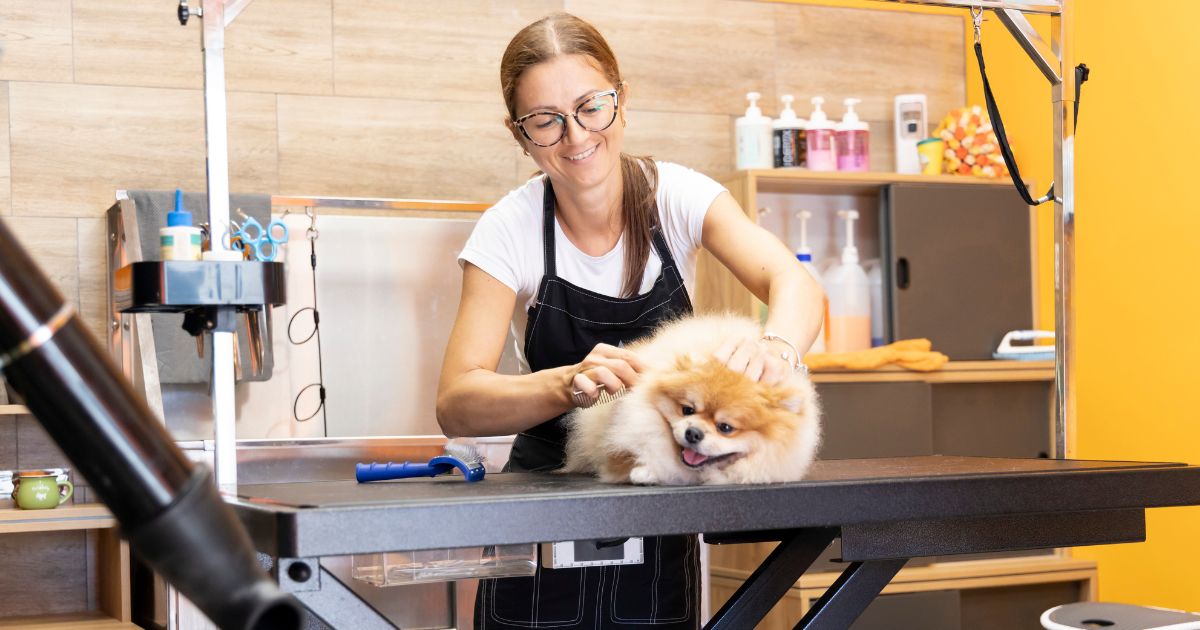
What Is the Zoomin Groomin Franchise Opportunity?
Company Overview and Industry
Zoomin Groomin is a mobile pet grooming franchise that brings pet care services directly to customers’ homes. Founded in 2003, the company began franchising in 2006. In 2021, Zoomin Groomin was acquired by Loyalty Brands, which spurred rapid expansion – growing from just 4 initial units to over 165 franchisees and 225+ franchised units within about two years. As of 2025, Zoomin Groomin has 211 franchise units operating across the United States. This dramatic growth even earned it a spot among the fastest-growing franchises (ranked #31 in 2025) and a strong Franchise 500 ranking (#233 in 2026).
Zoomin Groomin operates in the pet services industry, specifically focusing on pet grooming. The pet care sector is enormous and still growing – over 71% of U.S. households (around 94 million families) own a pet, and owners spend roughly $1,200 per year on their pets on average. Within that, the pet grooming market is projected to reach about $6 billion by 2026, with an expected growth of ~38% in the next five years. This means a Zoomin Groomin franchisee is tapping into a large, booming industry fueled by Americans’ willingness to pamper their dogs and cats. The business is headquartered in Virginia Beach, VA, and led by CEO Josh Fitzgerald, under the umbrella of Loyalty Brands. Notably, Loyalty Brands’ backing and experience have helped Zoomin Groomin scale nationwide, with franchise territories now open throughout the U.S. (no company-owned units; all locations are franchised).
In summary, Zoomin Groomin offers an opportunity in the mobile pet grooming space – a niche that combines the convenience of a home-service model with the strong demand of the pet care industry. Franchisees join a relatively young but fast-growing system that has expanded dramatically in recent years, reflecting the high demand for pet grooming services.
What Franchisees Get
A Zoomin Groomin franchise gives owners a turnkey mobile grooming business with a comprehensive package of services, support, and tools. Here’s what franchisees can expect:
- Full Pet Grooming Services: Franchisees operate a mobile pet salon on wheels, offering “nose to tail” grooming for dogs and cats. This includes bathing, fur trimming or haircuts, nail trimming, ear cleaning, teeth cleaning, and drying/styling – essentially all the services of a pet grooming salon, delivered at the client’s doorstep. The grooming van is outfitted with state-of-the-art equipment, such as a patented “wash basin to table” system, low-heat air dryers, and eco-friendly bathing systems that use 90% less water than traditional grooming tubs. Importantly, Zoomin Groomin’s model emphasizes pet comfort: no cage drying, a gentle and never-rushed approach, and accommodations for older or anxious animals to reduce stress. This focus on humane, high-quality pet care can be a major selling point to customers.
- Mobile Van and Technology: The franchise package includes a fully equipped mobile grooming vehicle (typically a van) or guidance on acquiring one. Franchisees can choose to purchase or lease the van; lease options are available that convert the upfront van cost into a manageable monthly payment. Each van becomes the “rolling storefront” of the business, complete with grooming stations and all needed tools. Zoomin Groomin also provides technology tools like a CRM system and scheduling software (franchisees pay a small tech fee for these services, e.g. about $10 per week for tech support and $69 per month for the CRM). These systems allow owners to schedule appointments and manage the business remotely from a phone, tablet, or laptop. In practice, an owner or manager can coordinate bookings and dispatch groomers to clients through an app or online platform, adding a high degree of operational flexibility.
- Training and Support: New franchise owners undergo comprehensive training to get started. Zoomin Groomin’s initial training currently consists of 4 hours of prerequisite virtual training followed by 3 days of classroom training at the company’s headquarters in Virginia Beach, VA. During training, franchisees learn the ins and outs of the business model – from grooming techniques and van operations to business management, customer service, and marketing. Because many owners do not come from a pet grooming background, the franchisor welcomes newcomers and teaches the business from the ground up (in fact, many recent franchisees had no prior experience and still achieved full booking schedules within 30 days of launching). Beyond the initial onboarding, Zoomin Groomin provides ongoing support such as weekly operations and support calls to check in with franchisees and offer coaching. The franchise system also holds an annual National Convention (franchise conference) that owners can attend free of charge, creating opportunities for continued learning and networking with fellow franchisees. Additionally, Zoomin Groomin offers recruiting assistance – helping franchisees find and hire qualified pet groomers – and maintains an intranet or communication platform where owners can access resources and share best practices.
- Marketing and Customer Acquisition: To help new franchisees ramp up, Zoomin Groomin includes a “Marketing Kick Start” program. This program spans multiple channels: targeted direct mail campaigns to pet owners in the territory, guidance on attending local community events (pet fairs, adoption events, etc.), social media marketing support, and even guerrilla marketing tactics to build buzz locally. Franchisees contribute 2% of gross revenue to a national advertising fund, which the franchisor uses for brand-wide marketing efforts. The franchisor also assists with website development, SEO, and ad templates for local use – for example, providing a local page on the Zoomin Groomin website, social media content, and email marketing programs to help attract and retain clients. As a mobile service, word-of-mouth and online reviews can be especially powerful, so the franchisor emphasizes delivering great customer experiences to spur positive referrals. Within a month of launching, many franchisees find demand is so strong that their schedules book out weeks in advance – a testament to effective marketing and the underlying pet owner demand.
- Exclusive Territory: Each Zoomin Groomin franchisee is granted an exclusive territory to operate in, usually defined by ZIP codes or county lines. A typical territory encompasses about 125,000 in population (the exact size can depend on density and other factors). Within that area, no other Zoomin Groomin franchise can open, giving the franchisee a protected market to build their client base. This ensures owners aren’t competing with each other; instead, they can focus on competing with independent groomers or other pet care options in the area. The territory can support multiple vans as the business grows – indeed, Zoomin Groomin notes that the “average deal” for new franchisees is 2-3 territories purchased together, indicating many owners opt to invest in a larger area with the plan to operate multiple grooming vehicles.
Overall, a Zoomin Groomin franchisee gets a complete business system: a defined service offering (mobile pet grooming with a unique approach), the physical equipment (grooming van and tools), training to operate effectively, ongoing support and technology infrastructure, and marketing assistance to drive growth. The customer base is primarily residential pet owners – this is a B2C model focusing on households with dogs or cats (the franchise does not specifically target B2B or commercial clients). Many clients schedule grooming on a recurring basis (e.g. monthly or seasonal grooming appointments for their pets), so franchisees can build up a roster of repeat customers. It’s a home-based business (no salon or storefront needed) that can be run either as an owner-operator (where you, as the owner, might also be a groomer or driver) or as an executive model where you hire groomers and focus on managing the business. In fact, Zoomin Groomin allows for semi-absentee ownership – some franchisees keep another job or business and hire staff to handle the grooming appointments day-to-day. This flexibility, combined with the joy of working with pets, is a big part of the franchise’s appeal.
Startup Costs and Ongoing Fees
Launching a Zoomin Groomin franchise requires a moderate initial investment, typical for a mobile service franchise. According to the Franchise Disclosure Document (FDD), the total initial investment ranges from about $64,974 to $205,400. The low end of that range assumes you finance or lease the grooming van and keep other startup expenses lean, while the high end reflects purchasing a new fully outfitted van outright along with all initial costs. Key components of the startup costs include:
- Franchise Fee: $45,000 (one-time). This grants you the rights to a Zoomin Groomin territory and the use of the brand and system. Veterans and first responders receive a 10% discount on the franchise fee as a thank-you incentive.
- Grooming Van and Equipment: The mobile van is the largest expense. If purchased new and fully customized, the van and upfit can cost on the order of $50,000 to $100,000+ (Zoomin Groomin’s 2024 FDD itemized the vehicle purchase at $5,500–$56,740 and the van upfitting/conversion at $36,000–$58,500). This accounts for installing grooming equipment, plumbing, power, and branding on the vehicle. However, franchisees have flexible options here: you can buy new, find a used van to convert (hence the wide range down to $5,500 on the low end), or lease through approved vendors to spread out the cost. Leasing can significantly reduce the upfront investment (often a few thousand down instead of tens of thousands) in exchange for monthly payments. Additionally, initial supplies like grooming tools, shampoos, and pet-safe cleaning products are relatively low-cost (around $200–$1,000) and are included in the startup budget.
- Training, Travel and Miscellaneous: New owners should budget for travel to training (if not local to Virginia Beach) at $500–$2,000, as well as initial insurance (~$2,000–$3,000) and licensing fees (~$400–$2,500). There’s also a recommended working capital reserve of $5,000–$10,000 for the first 3 months to cover operating expenses before revenue ramps up. All told, many franchisees likely invest somewhere in the mid-$100,000s to get their business rolling, with variation depending on the van financing approach.
In terms of financial requirements, Zoomin Groomin typically requires candidates to have a minimum net worth around $100,000 and liquid capital of $60,000 or more. This ensures the franchisee can secure financing for the van and sustain the business through the startup phase. Financing options are available through third-party lenders; the franchisor has relationships with financing sources that can fund the franchise fee, equipment, and even initial operating expenses for those who qualify.
Once operational, franchisees face the following ongoing fees and costs:
- Royalty Fee: 8% of gross revenue. This is paid weekly and is the franchisor’s main source of income, used to support the system. (There is a minimum royalty of $125 per week, which applies if your sales are very low in a given week).
- Advertising Fund: 2% of gross revenue. Collected to fund national and regional marketing efforts, as well as digital marketing campaigns that benefit the brand. Franchisees are also expected to spend some additional amount on local marketing in their territory (the franchisor provides templates and guidance for this) to keep the client pipeline full.
- Technology and Misc. Fees: As noted, there’s a small technology fee (currently $10/week) and a CRM software fee (~$69/month) that support the scheduling system and other tech tools. Franchisees must also maintain proper business insurance (cost varies by state, but the FDD estimates $2K–$3K annually) and vehicle insurance for the van. Standard business expenses like fuel for the van, maintenance, and groomers’ wages are of course part of the operating costs. The business can be run from home, so there is typically no lease or retail rent to pay (the FDD’s Item 7 even lists $0 for facility costs, though some owners might opt for a small storage unit or office which is optional).
- Master Franchise Option: An interesting note – Zoomin Groomin does offer master franchise or area developer opportunities. That means an investor could potentially buy the rights to a larger region and help sell/operate multiple units, but this is beyond the scope of a single-unit owner. For most franchisees, the focus is on running one or a few mobile units in their territory.
In terms of earning potential, Zoomin Groomin does provide an Item 19 (Financial Performance Representation) in its FDD. Recent figures are encouraging: for the 11 franchisee-owned vans that were operational for the full year 2023, the average annual gross sales per van was about $206,500, with the top-performing unit reaching $271,881 in sales. The median annual sales in that group was around $202,875. This suggests that a well-run Zoomin Groomin unit can generate roughly $15,000–$22,000 in revenue per month, on average. It’s worth noting that these numbers are based on a small sample of early franchisees (many franchises launched in 2022–2023 and hadn’t operated a full year yet, which is why only 11 vans were counted). Nevertheless, it shows that there is strong demand – a single mobile grooming unit can produce over $200K in annual sales serving a healthy base of pet owners. Of course, actual results vary, and franchisees must manage expenses (fuel, labor, etc.) out of that revenue, but the earnings claim demonstrates the revenue potential of the concept.
How the Industry Itself Compares
When evaluating Zoomin Groomin, it’s important to consider not only the franchise’s individual merits, but also the pet grooming industry it operates in – and how that compares to other industries you might invest in. In this case, since Assett Franchise is in the commercial cleaning industry, we’ll compare mobile pet grooming vs. commercial cleaning in practical, financial, and operational terms. Both industries involve providing services to clients on-site, and both can be run as relatively low-overhead, home-based businesses. However, there are significant differences in market dynamics, revenue models, and long-term scalability. Below we break down the advantages of Zoomin Groomin’s pet grooming industry and then contrast them with the advantages of the commercial cleaning industry in which Assett Franchise operates. The goal is to give an honest comparison – highlighting the strengths of pet grooming, but also showing why commercial cleaning is often considered a more stable and scalable opportunity for long-term business building.
Zoomin Groomin’s Pet Grooming Industry Advantages
Choosing a pet grooming franchise like Zoomin Groomin comes with some unique benefits tied to the pet industry itself:
- Booming Pet Care Market: The overall pet industry is massive (over $100 billion spent on pets annually in the U.S.) and still growing, which includes pet food, vet care, toys, and services. Grooming is a crucial segment of this industry – projected around $6 billion by 2026 – and rising demand is driven by pet owners who treat their pets like family. With 71% of households owning a pet, the customer pool is enormous. This cultural trend of pet “humanization” means many owners are willing to spend generously to keep their dogs and cats clean, healthy, and happy. For a franchisee, this translates into a steady base of potential clients who need grooming services on a recurring basis (dogs, in particular, require regular grooming for hygiene and comfort). The industry’s growth rate (nearly 38% growth expected in 5 years for grooming services) indicates a positive trajectory – a rising tide that can lift new franchise businesses.
- Fun, Fulfilling Work (for Pet Lovers): Running a mobile grooming franchise can be personally rewarding, especially if you love animals. Unlike some industries that might be more technical or B2B in nature, pet grooming is very tangible and heartwarming – you (or your groomers) spend the day making pets look and feel better. Many pet franchise owners enjoy the emotional satisfaction of working with animals and making pet parents happy by pampering their furry friends. This “fun factor” can be an advantage in terms of daily quality of life. It’s an industry driven by passion as much as profits – franchisees often build great relationships with repeat clients and their pets. If you’re leaving a corporate job, the idea of spending your workdays with adorable dogs and cats (instead of a desk or a spreadsheet) might be a breath of fresh air.
- Home-Based and Flexible: Pet grooming (especially the mobile model) offers a low-overhead, home-based business setup. There’s no need to lease a retail storefront or commercial office – your “shop” is the grooming van, and your operations can be managed from home. This keeps fixed costs low and makes it easier to launch and scale. The schedule can also be more flexible compared to some other service businesses. Grooming appointments are typically done during normal daytime hours (when pet owners are home or can hand off the pet), so you’re not necessarily working late nights or predawn hours. Franchisees have the freedom to set their own schedule to an extent; for example, you might choose to book grooms 5 days a week and be off on weekends, or vice versa, depending on local demand. This flexibility can be attractive for owners seeking better work-life balance. In fact, Zoomin Groomin explicitly allows semi-absentee ownership, meaning an owner can hire a full-time groomer (or a team) to handle the grooming while they handle scheduling and marketing part-time. That opens the possibility of keeping another job or business initially, or simply reducing your hours once the franchise is running smoothly.
- Lower Labor and Scale Requirements (Per Unit): A single mobile grooming unit doesn’t require a large staff. In many cases, it might start as a one-person operation (the owner-operator who drives the van and does the grooming). As the business grows, an owner can hire additional groomers or assistants, but the typical team size is small – perhaps 1-3 employees per van. This is a stark contrast to, say, a restaurant or a retail store that might need 10+ employees to cover shifts. Managing a smaller team can be more straightforward for first-time business owners. It also means each additional unit (van) you add doesn’t exponentially increase management complexity – you could scale to a fleet of 2-3 vans and still be dealing with a manageable team size. Additionally, the training and certification for pet groomers, while specialized, is a known process; groomers often attend grooming school or have prior experience, and Zoomin Groomin provides its own training for consistency. From an owner’s perspective, finding one good groomer to staff a van may be easier than hiring dozens of general workers, and those groomers can generate significant revenue per person (given the sales numbers, one van with one groomer can do $150K+ a year in sales).
- Strong Community and Repeat Business: Pet grooming tends to generate recurring revenue through repeat customers, albeit in a different way than a contract-based business. Pet owners usually groom their animals every 4-8 weeks, so if you deliver a great service, you’re likely to have loyal clients booking you for regular appointments year-round. Many Zoomin Groomin franchisees report being booked solid weeks in advance, indicating a high retention rate. Also, the service has a local community aspect – franchisees often get involved in local pet events, rescue organizations, and networking (e.g., sponsoring dog park days or partnering with veterinarians). This can strengthen your brand reputation in the community and lead to word-of-mouth referrals. While this is more of a marketing advantage than an inherent industry trait, it’s facilitated by the fact that pet owners often form tight-knit communities (think dog park friends, local pet Facebook groups, etc.). A grooming franchise owner who plugs into that community can become the go-to groomer in their area relatively quickly, yielding a nice book of recurring clients.
Of course, the pet grooming industry also has its challenges. It can be somewhat seasonal in certain climates (for instance, demand may spike in spring as dogs shed winter coats, or before holidays when people want their pets groomed for family gatherings, and potentially slow down in the very cold months). It’s also a mostly B2C, discretionary service – meaning it relies on consumers choosing to spend on their pets. During economic downturns, some pet owners might stretch the time between grooming or opt for cheaper at-home bathing to save money, which could affect sales. Additionally, growth beyond a point means acquiring more vans and training more groomers, which requires capital and effort in recruiting skilled staff (the pool of certified pet groomers is smaller than, say, the pool of general labor for other services). The safety and quality aspect is critical too – handling animals comes with responsibility and occasional difficulties (e.g., a nervous dog that’s hard to groom). These factors mean a pet grooming franchise can be a fantastic opportunity for the right owner, but it is not completely recession-proof or hands-off; it requires customer service finesse, a passion for pets, and attention to operational details to keep pets safe and owners satisfied.
Compared to Commercial Cleaning Industry
Now, let’s compare the above to the commercial cleaning industry, where Assett Franchise operates. In many ways, commercial cleaning offers broader and more scalable business opportunities when your goal is long-term stability and growth. Here are some key advantages of a commercial cleaning business franchise relative to a pet grooming business:
- Massive, Essential Market (>$100B): Commercial cleaning is a huge industry – worth over $100 billion annually in the U.S. – serving virtually every commercial building you can think of. Unlike pet services (which cater to individual consumers), commercial cleaning caters to businesses and institutions (office buildings, schools, medical facilities, warehouses, retail stores, etc.). Crucially, this market is driven by non-discretionary demand: businesses must maintain clean facilities as a basic operational need. Cleaning is not a luxury that can be skipped or postponed for long – even in recessions or downturns, companies need trash removed and restrooms cleaned. This makes commercial cleaning recession-resistant and even pandemic-resistant (in fact, cleaning demand often increases during health crises for sanitation reasons). By contrast, pet grooming, while important for pet health, can be viewed as discretionary – something pet owners might delay if finances get tight. The essential nature of cleaning translates to a more stable base of business. In short, the market size and stability in commercial cleaning far outstrip most personal service sectors.
- Recurring B2B Revenue: One of the biggest advantages of commercial cleaning is its recurring revenue model. Commercial cleaning contracts are typically ongoing arrangements – for example, a client might hire your franchise to clean their office 3 nights a week, every week, on a rolling basis. You’re not constantly reselling your service to new customers; instead, you build a portfolio of long-term B2B clients who pay monthly for recurring services. This means you start each month with a predictable baseline of income from contracts, smoothing out cash flow. Over time, a cleaning franchise can snowball by accumulating more contracts, which stack on top of each other. Hitting high revenue numbers (even $1M+ annually) is achievable by steadily adding accounts. For instance, a single large account like a hospital or university can be worth tens of thousands per month, and a handful of those contracts can get you to seven-figure revenues without hundreds of individual customers. Pet grooming, on the other hand, while it has repeat clients, usually involves one-off transactions (each grooming session is paid separately) and requires constantly booking appointments; there are no multi-year contracts guaranteeing a dog will be groomed every month. Thus, cleaning offers more predictable, contract-based income, whereas grooming requires continually marketing to and scheduling with consumers.
- Low Cost of Entry, High Income Potential: Both Zoomin Groomin and Assett Franchise are relatively low-cost franchises to start (especially compared to brick-and-mortar businesses), but commercial cleaning often has an edge in startup simplicity. There is no expensive vehicle or specialized equipment needed – a cleaning franchise typically requires basic cleaning tools and perhaps a small office, keeping initial investment low. Moreover, the income ceiling is high. Thanks to the recurring model and huge market, many commercial cleaning franchise owners are able to scale up to $1M+ in annual revenue by building a team and signing more contracts. Importantly, they can do this without a proportional rise in complexity or costs – adding a new cleaning contract might require hiring a couple more cleaners and buying a few more mops and vacuum cleaners, which is minimal compared to, say, buying another grooming van or expensive equipment. This combination of low startup cost and high scalability yields a very attractive ROI potential. In practical terms, a pet grooming franchise might max out after a couple of vans and a few hundred thousand in revenue (unless you invest heavily to expand further), whereas a commercial cleaning franchise can keep growing toward a seven-figure business with relatively small incremental investments.
- Semi-Absentee Operation (Flexibility): Commercial cleaning franchises like Assett are often designed to be run semi-absentee, meaning the owner does not need to be on site for the cleaning jobs and can manage the business in a limited number of hours per week. In fact, Assett Franchise is built for executive ownership with as little as ~5 hours/week of owner time once systems are in place. Here’s why: cleaning typically happens outside of regular business hours (nights or early mornings), and an owner can hire cleaning crews to handle the work. Because the tasks are standardized and routine, the owner’s role can focus on customer relationships, sales, and overseeing quality – tasks that do not require 40+ hours weekly once the business is stable. Pet grooming, on the other hand, usually requires more owner involvement or at least a closer eye on day-to-day operations. If you’re running a grooming van, you might need to manage bookings throughout the day and respond to consumer clients frequently, or even step in to groom if an employee is sick. It’s inherently harder to run completely hands-off, because skilled grooming labor is central to each sale. In contrast, a cleaning business owner can more readily step back and let trained crews work independently at client sites. This makes cleaning franchises ideal for those who want flexibility – you can have time for family, other ventures, or even keep a day job initially, because you’re not tied to a storefront or a van all day. Assett’s model exemplifies this with automated systems and hiring (more on that later) that reduce owner workload significantly.
- Easy to Scale, Minimal Equipment: Scaling up in commercial cleaning is straightforward. To service a new contract, you primarily need to add labor (hire more cleaners) and basic supplies. There’s no need to buy costly machinery or vehicles in most cases – a few additional vacuum cleaners or floor polishers are minor expenses. Cleaning tasks are relatively uniform (empty trash, vacuum, sanitize surfaces, etc.), so you can train new hires quickly and deploy them to new client sites. The labor pool for cleaners is also broad; you can find and train people without needing specialized certifications. This contrasts with a grooming franchise, where scaling means another $60K van and finding a certified groomer to operate it – a larger leap. Additionally, cleaning benefits from economies of scale: one supervisor can oversee multiple cleaning crews, and one salesperson can keep signing contracts, so as you grow, your per-unit overhead can actually decrease. You’re not constrained by territory population as tightly either; businesses are everywhere and often one franchise territory can contain hundreds of potential commercial clients. In short, commercial cleaning can grow from a small solo operation to a multi-crew enterprise relatively smoothly, without the owner needing to make big capital purchases at each growth step.
- Recession-Resistant and Non-Seasonal: Commercial cleaning is essential and performed year-round. Offices, schools, and facilities need regular cleaning regardless of season – there’s no slow winter or off-peak in the way some home services experience. Because it’s tied to operational necessity and often budgeted as part of a company’s operating expenses, it’s less subject to the whims of consumer confidence. Even when economic times are tough, companies might downsize but they won’t typically eliminate cleaning; if anything, they might outsource more to reduce internal staffing costs, which can benefit cleaning contractors. By contrast, many residential services (from lawn care to yes, even pet grooming) see more volatility – homeowners might cut back or delay services when money is tight. Commercial cleaning’s client base (businesses and institutions) tends to be more level-headed and stable. As an owner, you deal with professional facility managers or business owners who have set schedules and contracts. This means fewer last-minute cancellations, more predictable scheduling, and generally less emotional decision-making than in B2C services. You’re not dealing with a pet parent upset about a haircut; you’re working with clients who primarily care that their building is clean each week, and as long as you deliver, the relationship continues.
- Simpler Operations and Training: Running a cleaning business is operationally simpler in many respects. The procedures for cleaning are standardized and can be documented in clear checklists (vacuum floors, empty trash, disinfect bathrooms, etc.). This makes training new employees straightforward – you don’t need months of apprenticeship as you might for a pet groomer to learn breed-specific haircuts or handling techniques. The equipment for cleaning is also simple and relatively inexpensive – mops, cleaners, maybe a floor buffing machine – nothing like the expense of a commercial grooming van or maintaining pet grooming tools. Because of this simplicity, quality control is easier (it’s obvious if an office was cleaned or not), and there are fewer variables day-to-day. As the franchise owner, you’re not troubleshooting a wide variety of unpredictable issues; you’re providing a consistent service. This lower complexity means fewer headaches and also makes it ideal for first-time entrepreneurs. You don’t need industry experience (much like Zoomin Groomin also trains newcomers), but in cleaning, that learning curve is arguably even gentler. The core skills are management and customer service, not mastering a craft or dealing with animals. Many people find it easier to grasp running a cleaning operation than handling the nuance of pet care or other specialized trades.
In summary, the commercial cleaning industry offers a path to build a scalable, B2B business with recurring revenue, high demand, and relatively low complexity. The trade-off is that it might not have the “fun” appeal of working with pets or the personal passion element that a pet business has – cleaning isn’t glamorous, and you might not be a hero to anyone for taking out the trash. But for someone focused on business outcomes (reliable income, growth potential, flexibility), commercial cleaning tends to come out ahead as a long-term venture. It’s an industry where you can realistically build a million-dollar business that runs with a semi-absentee owner model, which is harder to replicate in most pet or home service franchises.
By contrast, the pet grooming industry is smaller and more consumer-dependent, can be more seasonal and limited in scalability (each van caps out at a certain revenue, and expansion is stepwise and capital intensive). It offers emotional rewards and can certainly be profitable, but it may not check all the boxes for someone whose priority is maximizing financial stability and growth. Next, we’ll look at how Assett Franchise leverages the advantages of the commercial cleaning industry, and how it specifically compares to the Zoomin Groomin model for an aspiring business owner.
How the Assett Franchise Compares
Having explored Zoomin Groomin and the pet grooming vs. commercial cleaning industries, let’s turn to Assett Franchise itself. Assett is a commercial cleaning franchise brand (founded and led by Matt Pencarinha) that was built intentionally for entrepreneurs seeking a simpler, scalable service business. In this section, we’ll compare how Assett’s model stacks up against an opportunity like Zoomin Groomin. Many of the cleaning industry advantages we discussed are baked into Assett’s offering by default – but Assett goes a step further by introducing modern systems and a hands-on support approach that truly set it apart. Here’s how Assett Franchise provides a “cleaner” alternative for those evaluating franchise options:
Simpler Systems, Bigger Potential
Assett Franchise is already in the commercial cleaning industry, so right away it inherits all the benefits we outlined above: a $100B+ essential services market, recession-resistant demand, and recurring B2B revenue streams. However, Assett’s real differentiation is how it makes the cleaning business model even simpler to operate for franchisees, while preserving the big upside potential. Assett was designed for owners who want to work on the business, not in it. This means as a franchisee you are not expected to spend your nights mopping floors; instead, you manage the business at a high level – focusing on client relationships and growth – and let systems and teams handle the day-to-day cleaning.
The systems in place are streamlined by design. Unlike a pet grooming operation where each day might bring a different mix of breeds, cuts, and customer preferences, Assett’s cleaning model is very consistent. Franchisees execute a repeatable cleaning program for commercial clients, which keeps operations predictable. The company provides a full business playbook that covers everything you need to succeed, from acquiring clients to servicing accounts to scaling up. Even if you have no prior industry experience, Assett’s training and playbook will teach you how to run a commercial cleaning company step by step. In fact, Assett actively targets first-time entrepreneurs and career changers – people coming out of corporate jobs who have strong management skills and drive, but not necessarily any cleaning background. The learning curve is accessible and the franchisor is heavily involved in coaching new owners.
Critically, Assett Franchise owners aim for high recurring revenue targets – the model is built with the expectation that hitting $1M+ in annual recurring revenue is achievable by accumulating the right mix of contracts. That figure isn’t just an aspirational marketing number; it’s grounded in the economics of the cleaning business (e.g., landing perhaps 20-30 medium-sized contracts could yield a seven-figure run rate). Assett’s franchise system emphasizes scaling up accounts in a sustainable way, rather than settling for a “mom-and-pop” size operation. This bigger potential is what draws many to commercial cleaning in general, and Assett makes it more attainable by removing many typical growth bottlenecks (like difficult hiring, which we’ll discuss next). In short, Assett offers a cleaning business franchise model that is simpler to operate but with even bigger upside potential in terms of stable, long-term income. It’s a modern take on a cleaning franchise: one that leverages technology and refined processes so that the owner can concentrate on strategic growth, confident that the day-to-day functions are under control.
Automated Hiring = Time and Money Saved
One of the biggest operational challenges in any service business – whether pet grooming or cleaning or something else – is hiring and retaining employees. Zoomin Groomin franchisees, for example, might struggle to find skilled groomers in a tight labor market, which can limit how many vans they can operate. Assett Franchise tackles the labor challenge head-on with a proprietary automated hiring system. This is a game-changer that virtually no traditional franchise (including pet franchises) offers.
Assett has developed technology and processes to continuously recruit, filter, and onboard cleaning staff on behalf of its franchisees. Instead of an owner spending hours posting job ads, sifting through resumes, and conducting interviews, much of that work is handled by Assett’s automated system. It’s like having a built-in HR assistant working 24/7 to keep your talent pipeline full. The system uses online ads, screening questionnaires, and even automated scheduling of interviews or training sessions to keep a steady flow of pre-vetted candidates coming in. The result is a huge time savings – roughly 20–30 hours per week of an owner’s time is freed up, compared to a typical service business where hiring is a constant headache. In fact, by automating recruitment, Assett essentially provides the value of a full-time HR manager at no extra cost to the franchisee.
What does this mean in practical terms? It means Assett owners can scale their workforce quickly to meet new contract demands without getting bogged down in the hiring process. For instance, if you land a big cleaning contract that requires five additional cleaners, Assett’s system likely already has a pool of qualified cleaners in the queue or can rapidly funnel new applicants your way. This ensures you can staff up reliably and rapidly, so you never have to turn down growth opportunities due to labor shortages. Each candidate is filtered and often pre-trained through Assett’s platform, meaning by the time they get to you, they are likely to be a good fit and ready to work. The automated hiring system also places an emphasis on quality – only vetted, qualified individuals make it through the pipeline, helping maintain high service standards across all cleaning teams.
By eliminating the biggest headache – labor churn and recruitment – Assett frees its franchisees to focus on growth and client service. You can spend your time building relationships with customers (which drives revenue) rather than constantly placing help-wanted ads. This is an especially important advantage when comparing against franchises like Zoomin Groomin or other home services, where finding skilled labor (groomers, technicians, etc.) can be a serious growth bottleneck. Assett’s approach not only saves time and money (by reducing the need for recruiting expenses or an in-house hiring manager), but it also contributes to better service quality – clients are happier when your team is fully staffed with trained people, and you as the owner aren’t stretched thin due to understaffing. In short, Assett Franchise has turned the hiring process into a competitive advantage, allowing owners to scale with far less friction. This kind of modern, automated system is part of what makes Assett a “business built for executive ownership.” It’s about working smarter, not harder, and it removes a pain point that often plagues small business owners.
Personalized and Founder-Led
Another key way Assett Franchise sets itself apart is through its culture and leadership style. Assett is a family-owned, founder-led company, not a faceless corporate franchise. The company’s founder, Matt Pencarinha, remains closely involved in the business and in supporting every franchisee, as stated in bizbuysell.com. When you join Assett, you’re effectively joining a smaller franchise family where the leadership knows you by name and genuinely cares about your success. Franchisees get direct access to the founder and executive team for mentorship, guidance, and problem-solving – this is a level of support that you simply won’t find in most large franchise systems.
In contrast, Zoomin Groomin (like many franchises that scale quickly under private equity ownership) is part of a larger corporate structure. It’s owned by Loyalty Brands, which oversees multiple franchise concepts. While Zoomin Groomin certainly provides support to franchisees, the nature of a big franchise network can be more hierarchical and “corporate.” As a Zoomin Groomin franchisee, you likely wouldn’t have direct access to the CEO of Loyalty Brands or a personalized relationship with the founder – you’d be working mainly with field support managers. Assett Franchise deliberately keeps its organization hands-on and personal. Matt Pencarinha and his team are accessible; you can pick up the phone and talk to leadership when needed, and advice comes straight from the people who built the business from the ground up.
Being founder-led also means Assett is driven by a clear mission and values, rather than just investor demands. The company is not controlled by private equity or a large conglomerate, so decisions are made with franchisees’ success in mind, not just short-term profits. This often manifests in more flexible decision-making and quicker innovation. For example, if franchisees collectively need a new software feature or have feedback, the leadership at Assett can implement changes faster without layers of corporate approval. The company prides itself on a community-focused model, encouraging franchise owners to build relationships not just with clients but within their local communities – through trust, reliability, and service. Assett wants owners to feel proud of the business they run and to know they are part of a team that shares their goals and values.
For many entrepreneurs, especially first-timers, this kind of personalized support is incredibly valuable. When you’re learning the ropes, having the founder in your corner, willing to share insights or help troubleshoot, can help you avoid pitfalls and accelerate your success. It creates a sense of partnership – you’re not just “franchisee #210 in a database,” but a member of a close-knit group all working towards building their businesses under a common brand. Assett’s franchisees aren’t at risk of feeling lost in the shuffle or like cogs in a machine; instead, they often comment that it feels like being part of a family business, with all the support and camaraderie that implies. This approach is a refreshing alternative to franchises backed by big corporations or equity firms where the vibe can be more transactional.
In summary, Assett Franchise offers a personal touch and founder-led ethos that stands in stark contrast to many franchise opportunities out there. If you appreciate working directly with the leadership of the franchise, having your voice heard, and being part of a mission-driven company, Assett provides that environment. This is the kind of support and culture that can make a big difference, especially in the early stages of building your business when you want to know that the franchisor truly has your back and a shared interest in your long-term success.
Final Thoughts
Zoomin Groomin is a respected franchise in the pet services space and could be the right fit for someone who is passionate about working with animals and doesn’t mind a more hands-on, owner-operator role (either doing grooming themselves or closely managing a groomer). It offers the chance to join a growing pet care market and can be quite fulfilling for the right type of buyer – especially one who values the day-to-day interaction with pets and pet parents. The Zoomin Groomin opportunity provides a proven model for mobile grooming, solid training, and a niche in a fun industry. However, when comparing it to a cleaner alternative like Assett Franchise, the advantages of commercial cleaning become clear. Assett Franchise offers more advantages for someone seeking a scalable, stable business with low operational complexity and predictable recurring revenue. It’s built to deliver long-term growth with minimal risk and faster ROI, leveraging a recession-resistant model and modern systems (like automated hiring) that remove much of the grind of running a service business. Because Assett is designed for executive ownership, it allows you to achieve the entrepreneurial dream with far more flexibility in your schedule and far less of the day-to-day stress.
In the end, the best franchise opportunity is one that aligns with your life goals and personal strengths. Zoomin Groomin may have its strengths – it can be a great fit for someone who loves the idea of a pet-oriented business and is comfortable with the limitations of a consumer service model. But Assett Franchise is purpose-built for entrepreneurs who want long-term income, flexibility, and control without many of the headaches found in other service industries. It delivers a path to building a “business that works for your life,” rather than you working around the clock for the business.
If you’re exploring franchise opportunities and want a model that can deliver long-term income, flexibility, and control — we’d love to show you how Assett Franchise can help you build a business that works for your life. Visit https://assettfranchise.com to connect with our team and learn more.